
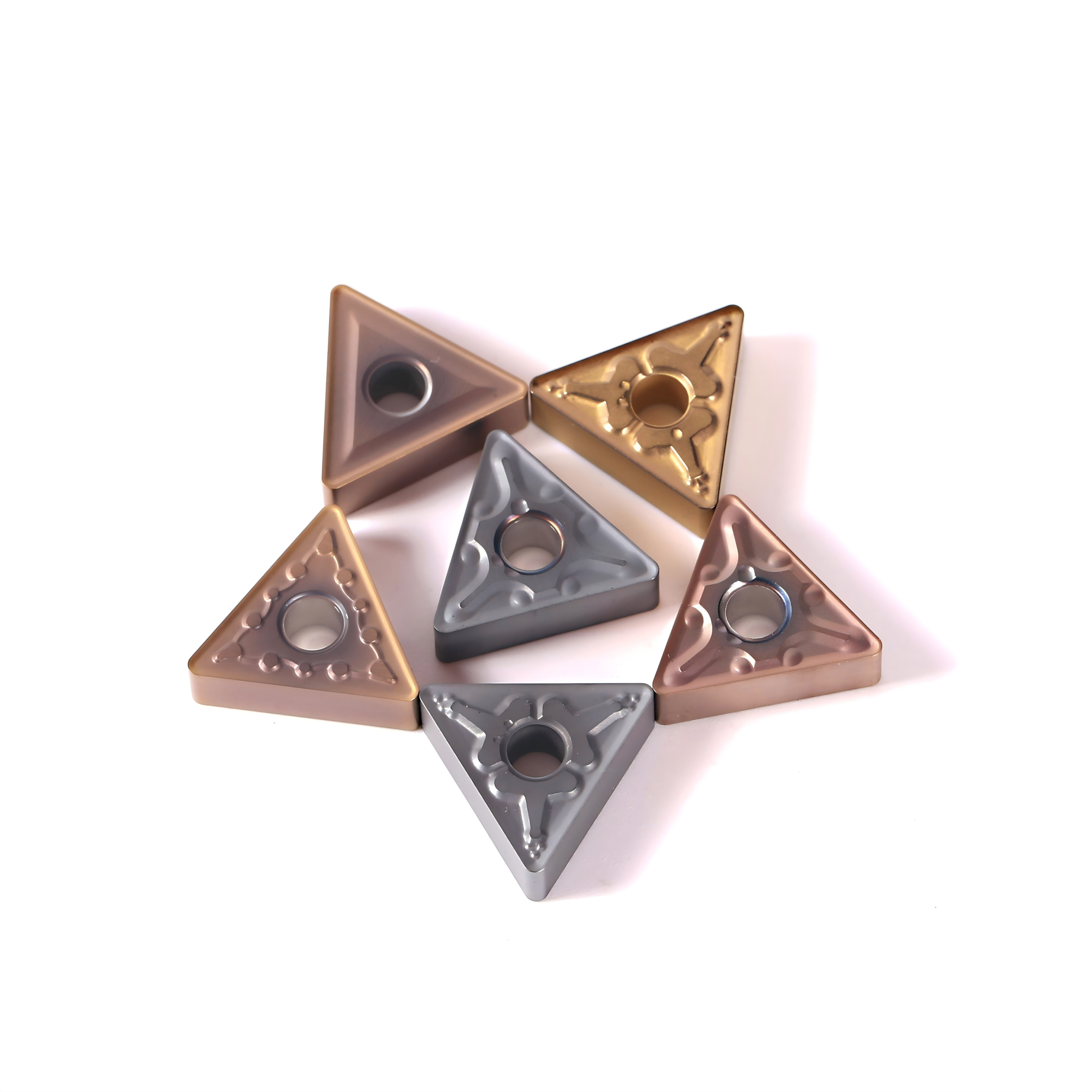
If you work with CNC lathes, you’ve almost certainly seen a TNMG insert in your toolroom. These triangular turning inserts are everywhere in modern machining, but many buyers still feel confused by the code, the dimensions and the different TNMG insert sizes.
In this guide we’ll decode the TNMG insert meaning, show how the ISO designation works and explain the most common TNMG insert dimensions such as TNMG 1604, TNMG 332 and TNMG 432.
What is a TNMG insert?
A TNMG insert is an ISO turning insert used for external and internal turning on CNC lathes. It has:
A triangular shape with a 60° included angle between the cutting edges CNC Of Course
A negative rake design, which gives strong cutting edges and allows use on both sides of the insert
A central hole for clamping into a TNMG insert holder
Because each triangle has three corners and both sides can be used, a typical tnmg carbide insert offers six usable cutting edges, giving very good cost-per-edge for high-volume production.
CNC lathe TNMG solutions in almost every industry: automotive shafts, hydraulic parts, general engineering and many more.
2. TNMG insert full form – decoding the code
The ISO code “TNMG” is not random. Each letter has a meaning according to ISO 1832 for turning inserts
T – Shape: triangular insert with 60° TNMG insert angle
N – Clearance: 0° clearance (a negative insert)
M – Tolerance class (medium accuracy)
G – Type of clamping / chipbreaker
When you see a full code such as TNMG 1604 or TNMG 332 insert, the numbers add more details:
First two or three digits: inscribed circle or “insert size”
Next two digits: insert thickness
Last two digits: nose radius
For example, TNMG 1604 carbide inserts usually mean a triangular insert with 16 mm (or 5/8″) inscribed circle, 4 mm thickness and a small nose radius. Charts from standards and tooling catalogs show the exact relationship between code and size.
3. TNMG insert size chart and key dimensions
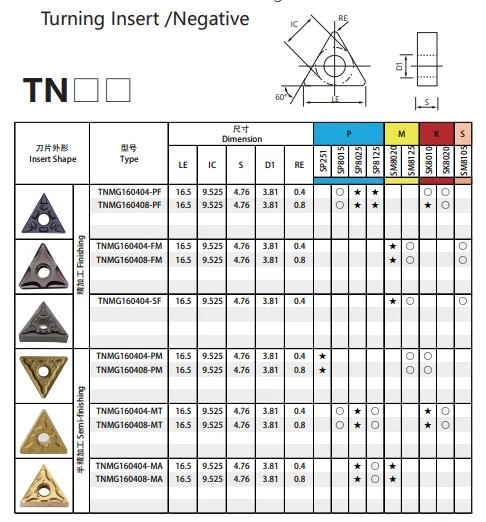
When you select an insert, you must match it to the toolholder. That’s why buyers always ask for the TNMG insert size chart or TNMG insert dimensions.
Main dimensions you should check:
IC – Inscribed circle diameter
S – Insert thickness
RE – Corner radius
H – Insert height, used to calculate IC for triangles
Typical ISO/ANSI sizes that appear in catalogs include:
TNMG 1604 / TNMG 332 insert – very common size for general turning
TNMG 2204 insert – larger IC for heavy cuts
TNMG 431 / TNMG 432 insert – inch-style sizes with different radii
If you buy inserts from different brands (Korloy, Taegutec, Tungaloy, Kennametal, Sandvik, Kyocera, Mitsubishi etc.), the ISO size is compatible as long as the holder is also TNMG with the same size code.
4. TNMG insert specification and material options
A complete TNMG insert specification normally includes:
Substrate grade: cemented carbide, cermet, CBN or ceramic
Coating: PVD or CVD TiN/TiCN/Al₂O₃, or uncoated for aluminium
Chipbreaker: for finishing, medium or roughing
Recommended workpiece materials and cutting parameters
Standard tungsten carbide insert TNMG grades cover steel, stainless steel and cast iron. Many suppliers also offer TNMG 1608 insert cast iron grades for deeper cuts, TNMG ceramic inserts and TNMG CBN insert versions for hard turning above 55 HRC.
5. Difference between TNMG and CNMG inserts
A common question is the difference between TNMG and CNMG insert.
TNMG – triangular shape; good for finishing and when you need access near centres or tight shoulders. It has six edges and is very economical.
CNMG – rhombic 80° shape; stronger corner for roughing cuts and heavier interrupted turning.
- In practice, many shops use CNMG for roughing and TNMG for semi-finishing and finishing.
6. Choosing your TNMG insert holder
To use the insert properly you need a matching TNMG insert tool holder. Make sure:
The pocket is TNMG-style (negative triangle)
The size matches your insert (e.g. insert holder for TNMG 331 sh)
The clamping method (top clamp, pin + clamp, wedge etc.) suits your application
Correct clamping improves stability and tool life, especially when you use small nose radii and light feeds for fine surface finish.
7. Final thoughts
Understanding the full form of TNMG insert, its dimensions and ISO nomenclature makes it much easier to order the right tools, compare brands and control your tool cost. Whether you need TNMG 322 insert for light turning, carbide cutting inserts TNMG 434 for heavy work or a special TNMG insert for aluminium machining, decoding the code is the first step.
If you’re looking for a reliable carbide TNMG insert manufacturer in China, Huana Tools (HNCarbide) can supply a complete iso type TNMG series tungsten carbide inserts line with clear drawings, size charts and technical support, so your CNC lathe runs safely and efficiently.