

Most confusion around “upcut vs downcut spiral router bit” disappears when you decide which surface matters most.
- Need a cleaner TOP edge (visible face)? A downcut spiral is often the first choice because it pushes fibers down, helping the top edge look crisp.
• Need a cleaner BOTTOM edge, or you’re cutting deep slots/pockets where chips must escape? Upcut is usually safer because it evacuates chips up.
• Need BOTH faces clean on plywood or laminated sheet goods during through cuts? Compression is designed for that, with an upcut section near the tip and downcut near the shank, so it can reduce tear-out on both faces when run at the right depth.
This is why “spiral router bit upcut vs downcut” is less about brand and more about surface control.
Chip evacuation and feed rate: why upcut can feel more “universal”
Chip evacuation is productivity. Many routing guides note that upcut bits eject chips efficiently and can allow faster feed rates, while downcut bits can trap chips in deep slots and therefore require slower feeds or shallower depth per pass. If you pocket MDF or run long dados in plywood, that chip clearing is why upcut often feels more universal—especially on CNC routers paired with dust extraction.
Downcut still has a place: it’s a finish tool for the top edge when depth is shallow enough to avoid packing.
The three spiral families compared
| Bit type | Chip flow | Strength on sheet goods | Best depth behavior | Best examples |
|---|---|---|---|---|
| Upcut | Up and out | Great for bottom edge; top may fuzz/tear | Excellent for deep slots/pockets | Dados, mortises, CNC pocketing |
| Downcut | Down into slot | Excellent top edge on veneers | Best for shallow pockets/grooves | Inlays, shallow grooves, clean top face work |
| Compression | Up at tip + down near shank | Often best for plywood through cuts | Must cut deep enough to engage both sections | Cabinet parts, laminate panels through-cuts |
Plywood: the “both faces” problem and why compression exists
Plywood is the material that creates the biggest debate. If you cut through with an upcut, you might get a clean underside but risk tearing the top veneer. If you cut through with a downcut, the top can look great but the underside may chip out, and chips can pack if the cut is deep. Compression bits exist because plywood often needs both faces to look good.
Important: compression bits work best when your cut depth engages both the upcut and downcut sections. On low-power CNC machines or handheld routers where you can’t do full-depth engagement, the compression advantage can be reduced. In those cases, many users choose a simple upcut or downcut and run multiple passes.
MDF: dust control is the whole game
MDF doesn’t have a grain to tear, but it creates dust that behaves like a heat blanket. Upcut is popular because it clears dust out of pockets and works with dust collection. Downcut can produce a crisp top edge on shallow work, but in deep pockets the dust can pack and burn. In MDF, prioritize evacuation, then optimize finish with a light final pass.

Acrylic and plastics: don’t let chips melt back into the cut
With acrylic, the enemy is heat. If chips stay in the cut, they re-melt and weld to the flute. Upcut helps by pulling chips out; combine it with feeds that form chips (not dust) and avoid dwelling in one place. Downcut can look cleaner on the top surface of thin sheets, but chip packing can show up quickly in deeper grooves. Air blast or good vacuum is your friend.
CNC vs handheld: workholding changes the answer
On a CNC router with a solid vacuum table or clamping, upcut’s upward force is manageable, and chip evacuation helps stability. On a handheld router, workholding is often the limiting factor. Downcut reduces lifting force and can feel more controlled on light fixtures. If you are routing small parts without excellent hold-down, downcut can reduce chatter and movement.
A decision tree you can paste into your SOP
Step 1: Which face must be clean?
• Top face -> downcut (shallow) or compression (through).
• Bottom face / deep slot -> upcut.
Step 2: Is the cut deep or a pocket/slot that traps chips?
• Yes -> upcut first.
• No -> downcut is fine.
Step 3: Are both faces visible on plywood and you’re cutting through?
• Yes -> compression (with enough depth).
• No -> choose based on which face matters.
Step 4: Is your workholding strong?
• Weak hold-down -> downcut reduces lifting.
• Strong hold-down -> upcut is efficient and stable.
Scenario table: real shop examples
| Scenario | Recommended bit | Why | Extra tip |
|---|---|---|---|
| CNC: pocketing MDF signage |
Upcut spiral router bit | Evacuates dust; stable pockets |
Final finish pass for clean walls |
| CNC: plywood cabinet parts through-cut |
Compression bit | Cleaner top and bottom edges |
Use full-depth engagement if possible |
| Handheld: shallow groove in veneered plywood |
Downcut spiral router bit |
Clean top veneer | Multiple shallow passes |
| CNC: acrylic slots | Upcut spiral router bit | Chip evacuation reduces melt risk |
Use air blast; avoid dwell |
| Handheld: small parts, light clamping |
Downcut spiral router bit |
Less lifting force | Use backing board for support |
| CNC: deep dado in hardwood |
Upcut spiral router bit | Clears chips; reduces burning |
Control stick-out; ramp entries |
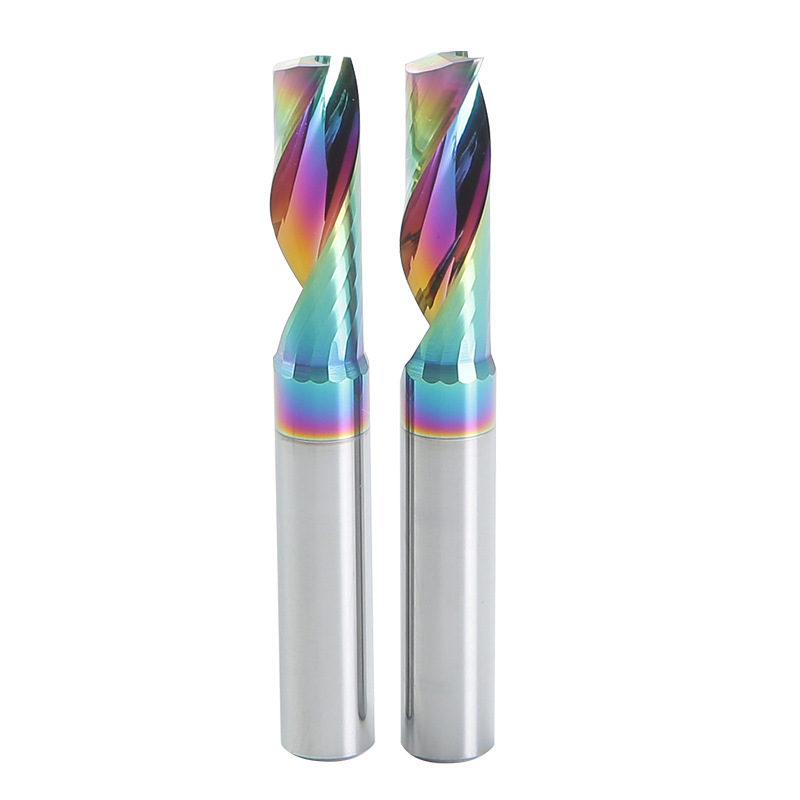
Should you buy an upcut spiral router bit set
A spiral upcut router bit set sounds convenient, but only if the set matches your real work. The best approach is a “core set” strategy:
• Pick your fast movers (often 1/8, 1/4, 3/8).
• Add duplicates of the size you use most (often 1/4).
• Avoid huge sets full of sizes you don’t use—those become drawer weight.
If you do want an upcut spiral router bit set for standardization, prioritize consistent flute length and the same carbide construction across sizes, so your feeds and finishes stay predictable.
Troubleshooting: what the cut is telling you
| Symptom | Most likely bit choice issue | Quick fix |
|---|---|---|
| Top veneer chips out | Upcut used on visible top face | Switch to compression (through) or downcut (shallow) |
| Bottom face chips out | Downcut used for through cut | Switch to compression or upcut; use backing board |
| Burned groove in MDF | Downcut packing dust in deep slot | Switch to upcut or reduce depth per pass |
| Melted acrylic edge | Chips re-cutting and heating | Use upcut with better evacuation; increase feed |
| Chatter on thin sheet | Upcut lifting the work | Improve hold-down or use downcut |
FAQ
1) Downcut vs upcut spiral router bit: which is better?
Neither is “better.” Upcut is better for chip evacuation and deep slots; downcut is better for clean top edges in shallow work.
2) Spiral router bit upcut vs downcut: what changes most?
Chip direction, which changes heat, chip packing risk, and which face looks cleaner.
3) When should I use compression?
Through cuts in plywood/veneers when you want both faces clean, and your cut depth engages the bit’s design.
4) Why does downcut burn in MDF pockets?
Dust can pack in deep cuts, increasing friction and heat.
5) Why can upcut pull the work upward?
Upcut helix creates an upward cutting force; weak clamping can allow movement.
6) Can I use upcut on everything?
It’s versatile, but for flawless top veneers you may prefer downcut or compression.
7) Do I need different bits for CNC vs handheld?
Often yes: CNC can benefit more from upcut’s evacuation; handheld workholding can favor downcut for control.
8) Is a set worth it?
Yes if you repeatedly use those sizes; otherwise build a smaller core set.