
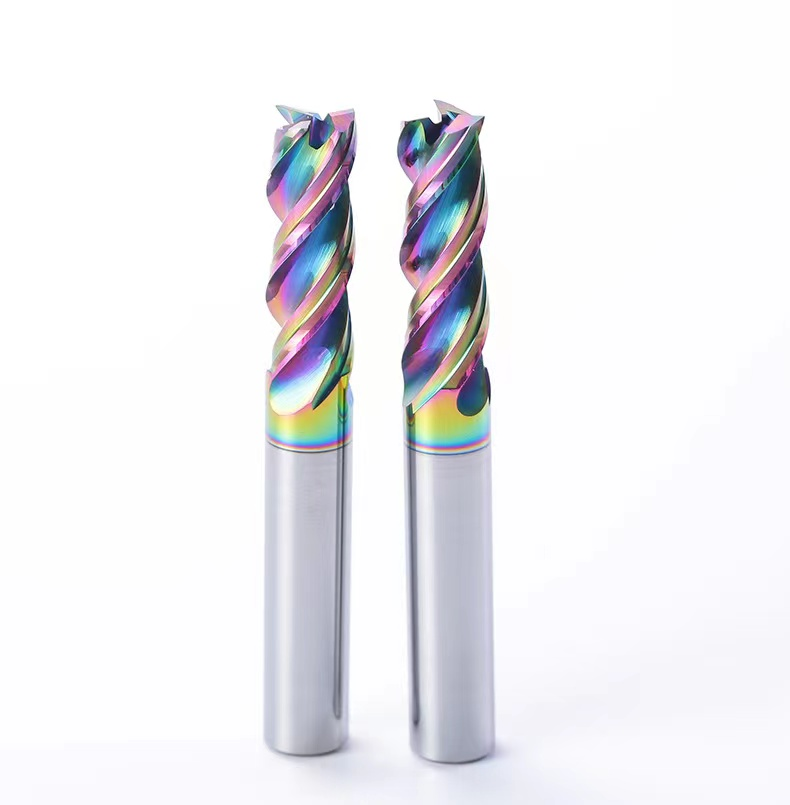
Manufacturing precision parts from aluminum can be challenging. The persistent issues in CNC aluminum machining can even keep production managers awake at night. Among these issues, tool wear holds a prominent place. When cutting tools fail prematurely, the ripple effects cascade through the entire production line. As a result, the production lines will experience issues such as unplanned downtime, increased labor costs, and missed delivery deadlines.
It is true that the excellent machinability of aluminum makes it an attractive choice for high-volume production. However, its tendency to adhere to cutting edges create built-up edge formation. This creates accelerated cutting tool wear. Traditional carbine end mills often struggle to maintain their geometry when subjected to the demanding conditions of high-speed aluminum machining.
This case study examines how a Canadian automotive parts supplier named Precision Components overcome these challenges by using the DCL-coated end mill technology of Huana. You can explore how they could achieve remarkable improvements to overall tool life while enhancing operational efficiency.
Client Background – Precision Components Ltd.
Precision Components Ltd operates a 24,000 square foot facility in Windsor, Ontario. They specialize in manufacturing high-precision aluminum components for the automotive industry. The company delivers OEMs across North America, which ranges from transmission housings to engine brackets. These OEMs offer tolerance measured in thousandths of an inch.
The production floor of Precision Components house 12 different CNC machining centers. It mostly contains Haas and Mazak machines. They run shifts to meet the demanding production schedules. The facility also processes around 15,000 aluminum parts every single month. They have batch sizes that range from 500 to 5,000 pieces. It all depends on what the customer requirements are.
Production Specifications
Parameter | Details |
Primary Material | 6061-T6 and 7075-T6 aluminum alloys |
Typical Part Size | 50mm to 300mm diameter |
Surface Finish Requirements | Ra 0.8 to 1.6 micrometers |
Production Volume | 15,000 parts per month |
Operating Hours | 20 hours per day, 6 days per week |
The overall reputation of this company relies on the quality of parts they manufacture. On top of that, they are in a position to cater to aggressive delivery schedules as well. Any disruption in the machining operations can eventually create a direct impact on overall profitability.
The Challenge – Persistent Tool Wear Issues
Before partnering with Huana, Precision Components had to deal with numerous interconnected issues. The most common issue out of them was around excessive wear of cutting tools.
Specific Problems Encountered
Frequent Tool Changes
Production teams had to change end mills every 200 to 300 parts. This is far below the industry benchmarks. These replacements disrupted the overall production flow, while increasing labor costs.
Poor Quality in Surface Finishes
When tools wore down, it was difficult to ensure smooth surface finishing. As a result, it required additional finishing operations to ensure end product quality.
Built-up Edge Formation
The tendency of aluminum to weld onto cutting edges created built-up edge (BUE) formation. It resulted in poor surface finishing along with dimensional inaccuracies.
Inconsistent Tool Performance
The lifetime of tools varied between different machines and operators. As a result, it made difficult to ensure smooth outcomes from production planning or inventory management.
Financial Impact
These cumulative effects resulted in massive financial losses as well. Here’s a breakdown:
- Total costs – $180,000 annually on aluminum machining tools.
- Downtime – 45 minutes per shift for tool change.
- Rework – 8% of parts required additional finishing operations.
- Labor – Labor required additional 2.5 hours per shift.
Production Manager Sarah Mitchel was not happy with this negative impact. She expressed her frustration: “We are constantly fighting tool wear issues. Soon after handling one batch, another would come with completely different results. It was impacting our ability to quote competitive pricing and maintain delivery schedules”.
Huana Solution – DLC-Coated End Mill Technology
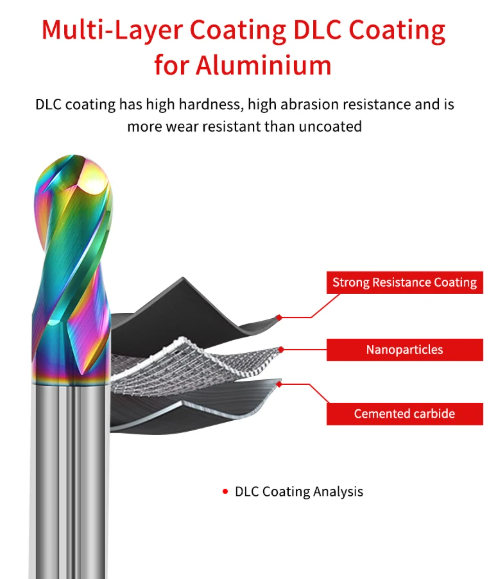
DLC-Coated End Mill Technology
After evaluating few potential solutions, Precision Components decided to partner with Huana. Huana is a leading CNC cutting tool manufacturer in China. They helped Precision Components to implement their advanced DLC-coated end mill for aluminum technology. It was designed specifically for aluminum machining tools and applications that Precision Components was using.
Technical Benefits of DLC Coating
Diamond-Like Carbon Properties
DLC Coating offers exceptional hardness while maintaining a low friction co-efficiency. This unique combination prevents aluminum from adhering to the cutting edge. It also offers excellent cutting tool wear resistance.
Optimized Geometry for Aluminum
The custom CNC tools by Huana feature specialized geometry. It is ideal for aluminum machining as:
- Sharp cutting edges can minimize cutting forces.
- Polished flute surfaces can reduce friction along with heat generation.
- Optimized helix angles can improve chip evacuation.
- Variable pitch design can reduce chatter and vibration.
.
Product Specifications
The solution centered around Huana 2-flute DLC-coated end mill is ideal for aluminum applications.
Specification | Details |
Coating | Diamond-Like Carbon (DLC) |
Substrate | Premium carbide with 10% cobalt content |
Flute Count | 2 flutes for optimal chip evacuation |
Helix Angle | 45° for balanced cutting forces |
Corner Radius | 0.1mm for enhanced edge strength |
Diameter Range | 6mm to 20mm (custom sizes available) |
Implementation Process
The transition to Huana high-performance milling tools involved a systematic approach.
Phase 1 – Trial Testing
Initial trials were focusing on the most problematic operations. The DLC-coated end mill was tested against the existing carbide end mills for aluminum under identical conditions.
Phase 2 – Parameter Optimization
By collaborating with the technical team of Huana, it was possible to optimize the cutting parameters. Results included:
- Increasint cutting speed from 1,200 to 1,800 SFM.
- Optimizing feed rate to 0.15mm per tooth.
- Maintaining an axial depth of 2mm for roughing operations.
- Increasing radial depth to 8mm for enhancing stability
Phase 3 – Full Implementation
After successful trials, the DLC-coated end mill was implemented gradually across all aluminum machining operations.
Results – Measurable Improvements Across All Metrics
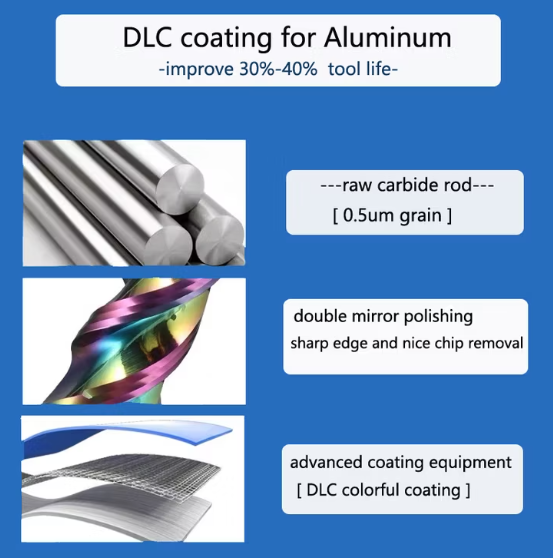
DLC Coating for Aluminum
The implementation of Huana DLC-coated end mill technology could deliver impressive results. These results could even exceed initial expectations. The company documented improvements over a period of six-months. During this time, they compared performance against the operational data captured in past 12 months.
Improvements to Tool Life
The most significant improvement was on improving tool life.
- Precision Components experienced a 40% overall increase in tool life. They noticed that tools now last 420 to 480 parts when compared to 200 to 300 parts as in the past.
- They could reduce the overall tool life variation from ±30% to ±10%. This could offer consistent performance.
- Precision Components also experienced more predictable wear patterns. It eventually facilitated better production planning and inventory management.
Gains in Operational Efficiency
The extended tool life eventually made the company go for fewer tool changes. It resulted in massive gains in operational efficiency.
- Precision Components experienced a 30% reduction in tool changes. There were around 4 to 5 tool changes per shift, but it was reduced to 2 to 3 changes.
- They could save 15 minutes per every tool change. It improved the setup procedures and tool organization as well.
- Precision Components could increase overall machine utilization. It added 25 extra minutes of cutting time per shift.
Improvements to Surface Finish Quality
Precision Components could immediately experience improvements to surface finishing.
- They noticed consistent Ra 0.6 to 0.8 micrometers. Previously, this could be achieved only with fresh tools.
- Precision Components eliminated secondary operations as well. That’s because 95% of the manufactured parts now meet finishing requirements right out of the machine.
- They also reduced the scrap rates from 3.2% to 0.8%. Improved dimensional accuracy played a major role here.
Analysis of Cost Savings
Financial benefits were more than just simple tool cost reductions. Here’s a better overview of overall cost savings.
Cost Category | Previous Annual Cost | Current Annual Cost | Savings |
Tool Purchases | $180,000 | $135,000 | $45,000 |
Downtime Costs | $95,000 | $65,000 | $30,000 |
Rework/Scrap | $42,000 | $18,000 | $24,000 |
Labor (tool changes) | $28,000 | $20,000 | $8,000 |
Total Annual Savings |
|
| $107,000 |
Improvements to Quality
Apart from cost improvements, Precision Components could experience quality improvements as well.
- They improved overall dimensional consistency by enhancing part to part variation by 25%.
- The company could achieve surface finish uniformity by eliminating finishing related customer complaints.
- Reduction of inspection time was another significant achievement. They could reduce quality control requirements by 20%.
Technical Analysis – Why DLC Coating Works
The overall success of Huana DLC-coated end mill originates from its unique properties of diamond-like carbon coating. It creates a unique interaction with aluminum during the machining operations.
Performance of Coating Characteristics
Low Friction Coefficient
CLC coating exhibits a low friction coefficient of 0.1 to 0.2 against aluminum. This is 0.4 to 0.6 in uncoated carbide. This dramatic reduction prevents aluminum from adhering to the cutting edge. It eliminates overall built-up formation as well.
Thermal Stability
The coating maintains its properties at temperatures up to 400°C. This is well above the typical aluminum machining temperatures. This stability ensures consistent performance throughout the life of the tool.
Chemical Inertness
DLC Coating is chemically inert. As a result, it prevents reactions with aluminum that can result in tool degradation. It also eliminates workpiece contamination.
Machining Parameter Optimization
The coating properties could enable significant improvements to machining parameters as well.
Increasing Cutting Speed
Higher cutting speeds of 1,8000 SFM when compared to 1,200 SFM improved overall productivity. This didn’t create any impact on tool life.
Aggressive Feed Rates
The low friction properties allowed for more aggressive feed rates. It didn’t compromise the surface finish or tool life.
Dry Machining Capability
In most applications, it was possible to eliminate flood coolant. This reduced costs as well as environmental impact.
Client Feedback – Real World Validation
The transformation at Precision Components didn’t go unnoticed. Sarah MItchenl, who serves as the Production Manager, offered detailed feedback on this implementation.
“We could experience a noticeable difference within the first week of testing. Our operators immediately commented how much cleaner the parts looked when coming out of the machine. But what really sold us was the consistency. We could finally predict when tools needed changing, instead of continuously have to check for wear”.
“The DLC coated end mill has become our go-to solution for aluminum work. We have even started recommending Huana to other shops in our network. The results speak for themselves, and we have no doubts in recommending”.
Operator Acceptance
Machine operators were initially skeptical about changing from their familiar tools. However, they quickly embraced the new technology.
- Predictable tool life eliminated guesswork for all machine operators.
- They could experience improvements in job satisfaction. That’s mainly because the operators had to spend less time on tool changes.
- Machine operators could improve their skill development as well. Consistent results helped them to focus on optimization, instead of troubleshooting.
Management Perspective
From management perspective, the benefits could extend beyond shop floor.
- Managers could experience an improvement in customer relationships. Consistent quality and on-time delivery was quite impressive.
- Precision Components could enhance their overall competitiveness in the industry as well. That’s because they could offer products to the market with more competitive pricing.
- They could reduce overall stress as well. That’s because they were able to predict operations, while improving planning and scheduling operations.
Conclusion – Huana is Transforming Manufacturing
Operations
This case study from Precision Components Ltd. Demonstrates how important it is to select the right CNC machining supplier. Moreover, it highlights the importance of implementing advanced tool technology to transform manufacturing operations.
Huana DLC-coated end mill technology could enhance overall tool life by 40%. This is not just a technical achievement. It showcases a fundamental shift in how manufacturers could approach productivity and quality challenges.
Are you ready to achieve similar results in your aluminum machining operations? Huana team of application engineers is ready to analyze your specific challenges and deliver customized solutions. They can offer measurable improvements to tool life improvement, surface quality, and operational efficiency.
Contact Huana Tools for your custom CNC solutions today. We will help you explore how our DLC-coated end mill technology and application-specific solutions can deliver competitive advantage. If you need to succeed in the demanding manufacturing environments of today’s world, you must take the decision to work with us.