
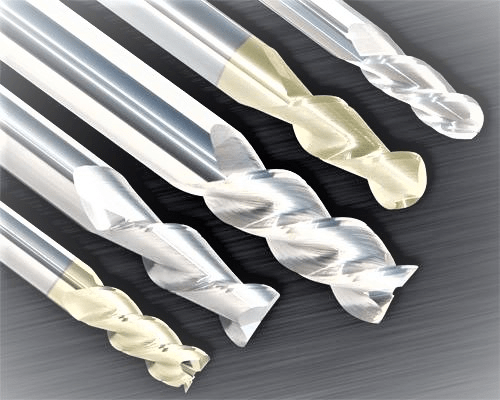
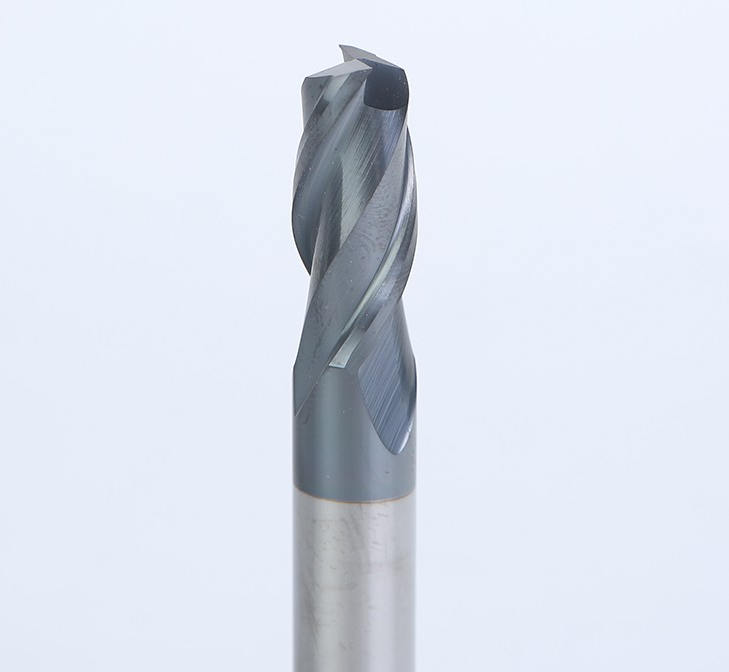
There are three possible end geometries: square, spherical, or corner radius. They are also available in the form of tiny end mills. They come with PVD coatings of TiN, TiCN, and AlTiN as options to choose from. They range in diameter from.005 inches all the way up to 1 inches. The 2-blade end mill er is used to process the keyway in most cases, and it provides superior cutting. In carbon steel, alloy steel, die steel, tool steel, cast iron, and titanium, a 2-blade end mill can be used for side milling, end milling, and finish machining. When it is difficult to remove chips from slots and grooves, a centre cutting operation, also known as a plunge cut, requires the use of a 2 flute end mill. Titanium Nitride (TiN), Titanium Carbon Nitride (TiCN), Titanium Aluminum Nitride (TiAlN or AlTiN), and Diamond finishes are just some of the many types of coatings that are available. These coatings provide for optimal performance and value for a specific application or material. There is a choice between metric and standard measurements for the cutting diameter and the shank..
2. 4-Flute End Mill
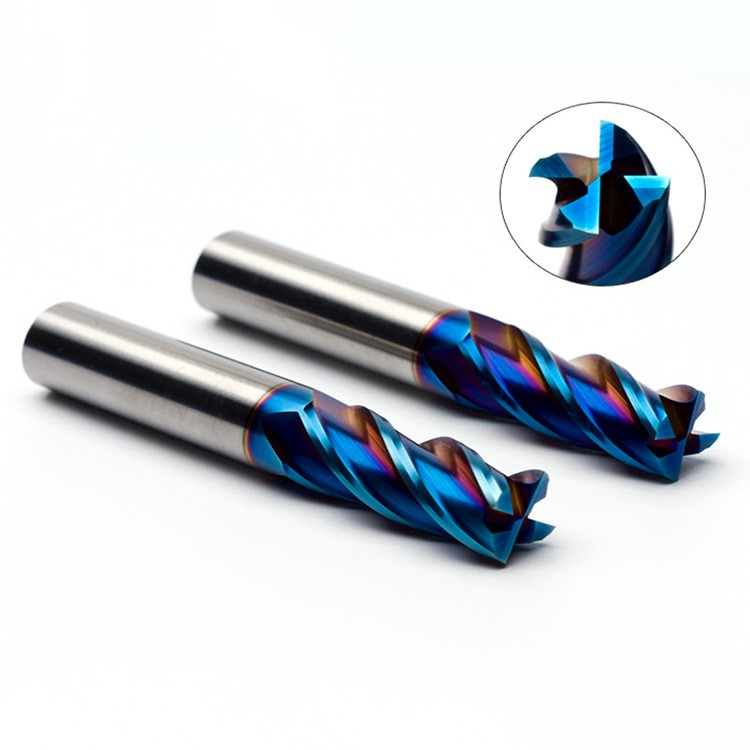
Surface milling and side milling are the two most typical uses for a 4-flute mill, despite the fact that this type of mill is capable of producing the same outcomes as a 2-flute mill, such as the creation of pockets and slots. End mills with four flutes are required for use in all steps of the end milling process. Despite the fact that mills with four flutes have a lower flute volume than mills with a greater number of flutes, mills with four flutes are the most common number of flutes. Because there are now more flutes than before, the feed rate may be increased. Because there are so many chips packed into such a limited space, it is probable that their performance in grooving operations will not be as good as it might be. End mills with four flutes that are designed for use with steels, tool steels, and cast iron. These end mills are available in a variety of profiles and key types, each of which is vital to the end result of the CNC machining application that you are working on.

This particular variety of end mill features four cutting blades and may be utilised to cut through a variety of materials, including hardened and high alloy steels, steel casting, chill casting, brass, copper, aluminium with a high percentage of silicon, and abrasive plastics. It is possible to increase the feed rate for a component, and the end mill’s four blades will provide an exceptionally smooth finish on the component. End mills with four flutes are often the tool of choice when performing typical milling operations such as cutting slots, profiling, and plunge cutting. End mills with four flutes have a strong resistance to heat and are often used for high-speed cutting of hardened materials such as iron, alloys, and other similar substances. This is because these end mills have the ability to cut more efficiently through the material’s microstructure.
3. 6-Flute End Mill
End mills for steels that contain six flutes, each of which is designed to have a longer useful life in the particular CNC machining applications in which they are employed, including high-efficiency milling. For finishing operations that need increased feed rates in addition to a high quality surface finish, end mills with six flutes are the tool of choice because of their versatility. Rough milling cannot be done with mills that have six flutes since these mills have a substantially lower flute volume than mills with more than six flutes. This ball profile variable pitch end mill features six flutes for optimal performance in light profiling, High Efficiency Milling (HEM), and finishing operations. The completed items have a superior quality as a direct result of the reduction in noise and harmonics that took place throughout production.
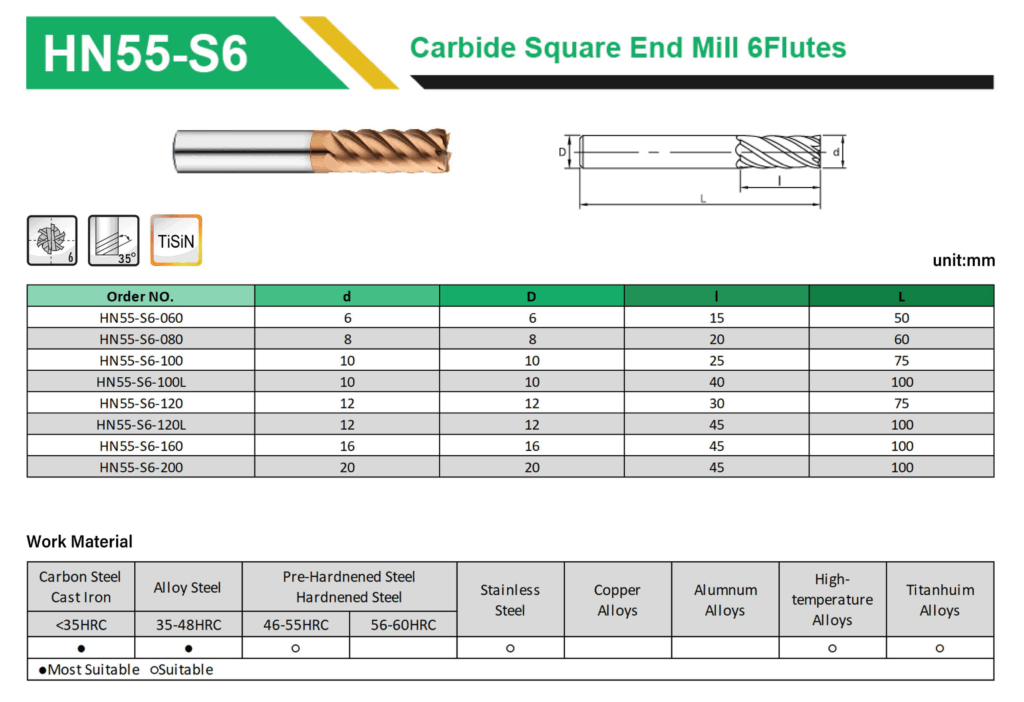
End mills with six flutes give great performance in a wide range of ferrous materials, such as steels with low and medium alloy content, tool steels, and cast iron. This includes all of the aforementioned materials. These end mills can withstand high temperatures without being damaged. End mills that have six flutes are optimized for use in processes that include light profiling, High Efficiency Milling (HEM), and finishing operations. These end mills are designed to perform very well in these processes. By utilizing 6-flute end mills with variable pitch geometry, manufacturers are able to produce higher-quality components while also cutting down on chatter and harmonics. When it comes to applications that call for longer reach and deep pocketing, a six-flute end mill with a shorter neck provides the maximum amount of strength possible.
2-flute End Mill VS 4-flute end mill VS 6-flute end mill
End mill flutes are normally available in one of three different conventional arrangements, with either two, four, or six cutting edges. Because of the greater room that is required for much bigger chips to evacuate when the tool is running at a quicker feed, it has traditionally been suggested that two-flute end mills be used when cutting aluminium materials. This is because of the increased space that is required. This is because the greater space makes it possible for chip evacuation to take place in a more efficient way, which is the reason for this.
Because they have more cutting surfaces that may make contact with the component during each revolution, 4-flute end mills have become the tool of choice for use in the machining of steel and other similarly hard metals. This is due to the fact that they have more cutting surfaces that may make contact with the component during each revolution. This is because they have a greater number of cutting surfaces, each of which has the potential to come into touch with the component at some point during each revolution. When milling away metal from a workpiece, employing end mills that have four or more flutes can be helpful in increasing the pace at which the metal is removed from the workpiece. This is because tougher metals require a lower input rate than softer metals do in order to be successfully processed.
Even with difficult-to-work-with materials, end mills with 4 and 6 flutes are able to perform exceptionally well. This is because of their design. The AlTi coating that is standard on HUANA end mills gives outstanding hardness and a prolonged tool life in high-temperature alloys and ferrous materials up to 45Rc. This coating can withstand temperatures as high as 450 degrees Celsius. This is accomplished by placing a protective barrier between the instrument that is being used and the substance that is being worked with. Because of the chip thinning capabilities of the tools in question as well as the tool shape that is applied with continuous radii, the tools end up being more rigid as a combined effect of these two factors. As a direct consequence of this, the instruments may be employed at higher feed rates. In addition to this, all of the cutting forces are directed upwards into the spindle, which helps to prevent vibration as well as deflection.
In the past, placing an order for end mills with 3, 5, or even 7 flutes was not conceivable; however, this is no longer the case in today’s modern world. When cutting aluminium or other non-ferrous materials, 6-flute carbide end mills have become increasingly popular because they offer superior productivity and finish in comparison to traditional 2-flute end mills without obstructing chip evacuation. This is possible because 6-flute carbide end mills have six flutes instead of two. This is achievable due to the fact that 6-flute carbide end mills contain six flutes rather of only two. This is because, unlike 2-flute carbide end mills, 6-flute carbide end mills feature six flutes. End mills with bigger counts of six flutes are becoming increasingly popular because of the enhanced efficiency they provide while cutting harder materials. As a consequence of this, a tool that has a greater flute count is capable of having more strength and experiencing less wear, which finally results in the tool having a longer life. End mills with bigger counts of six flutes are becoming increasingly popular because of the enhanced efficiency they provide while cutting harder materials. When dealing with particular kinds of ferrous materials, speciality applications typically find that having a high flute count is advantageous for a variety of reasons. This is the case for a number of different reasons.
Conclusion
To summarize, the number of flutes that an end mill possesses is directly proportional to the tool’s overall strength as well as its capacity to provide a faultless finish. However, in order to guarantee that any chips have space to clear while the operation is being conducted, lighter metals may require a lower flute count than heavier metals. If you have any questions or would need some guidance regarding the appropriate number of flutes for your end mills, please do not hesitate to get in touch with HUANA at any point throughout the course of the current day. End mills can have anywhere from two to six flutes, and we have staff members standing by to assist you in finding the end mill product that is most suited to satisfy the needs of the metalworking project you are working on.